
Why Every Small Business Needs an AI Answering Service
The phone rings. Nobody answers. You just lost a customer.
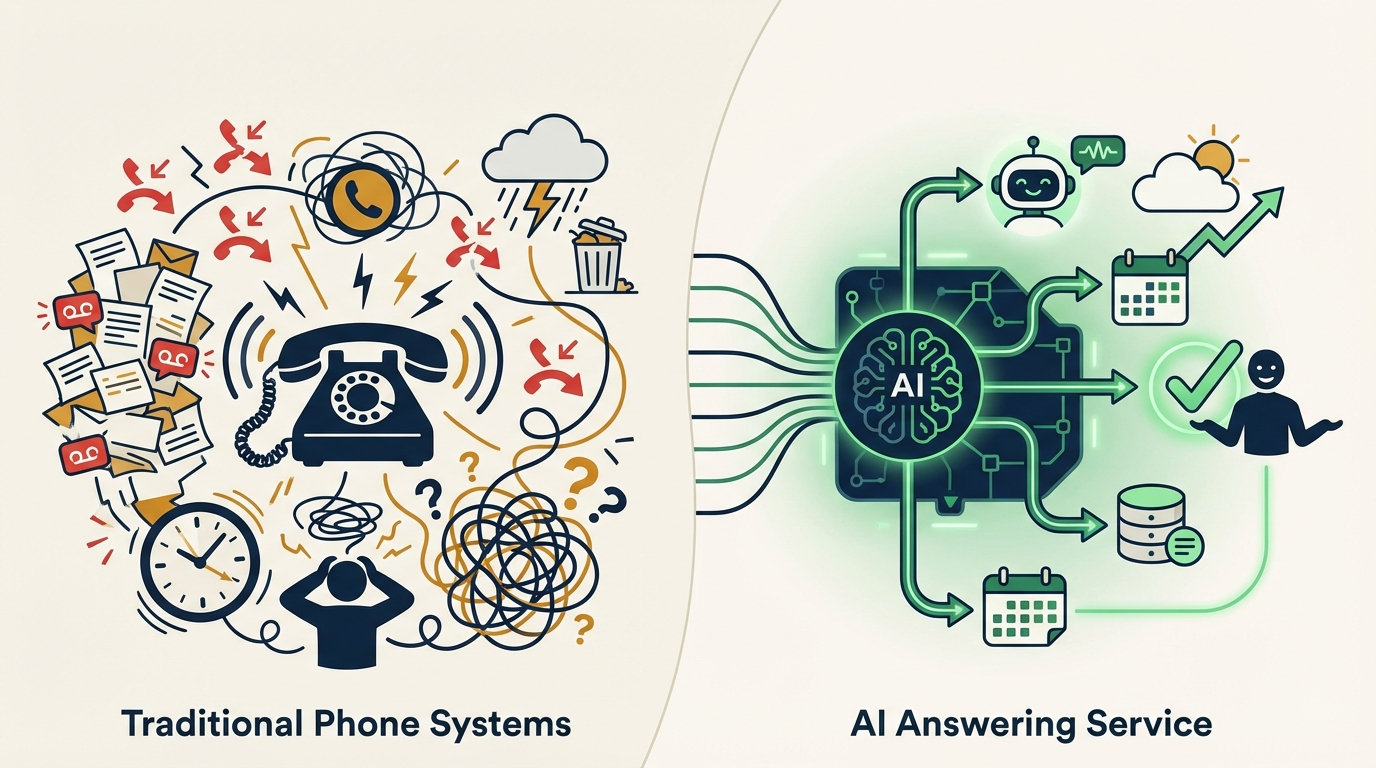
It happens more than you think. According to Ambs Call Center’s 2026 report, small businesses answer only 37.8% of inbound calls. The rest go to voicemail — or worse, ring out to nothing.
For a plumber in Charleston, an HVAC company in Morgantown, or a vacation rental manager in the New River Gorge area, every missed call is a missed job. And the numbers are brutal: small and mid-sized businesses lose an average of $126,000 per year to unanswered calls. That is not a rounding error. That is a full-time employee’s salary walking out the door.
An AI answering service changes the math entirely. It picks up every call, qualifies every lead, and books appointments around the clock — for a fraction of what a live answering service costs. Here is how it works and why it matters for your business.
The hidden cost of missed calls
Most business owners know they miss some calls. Few realize how much it costs them.
The numbers are worse than you think
A study on business phone statistics found that 37.8% of business calls go to voicemail, and another 24.3% receive no answer at all. That means nearly two out of three callers never reach a human.
The damage compounds from there. Research shows that 80% of callers who reach voicemail hang up without leaving a message. They do not call back. They call your competitor.
For service businesses — the backbone of Appalachian communities — this hits especially hard. A homeowner with a burst pipe at 9 PM is not going to leave a voicemail and wait until morning. They are going to call the next plumber on Google until someone picks up.
Speed matters more than you realize
The Harvard Business Review published a landmark study on lead response time that still holds true. Companies that contacted leads within five minutes were 21 times more likely to qualify them than companies that waited 30 minutes. Move that response time from 5 to 10 minutes, and your odds of qualifying the lead drop by 400%.
Yet the average business response time to a new lead is 42 hours. By then, the customer has already hired someone else.
What this means in dollars
Here is a simple calculation for a service business:
| Metric | Estimate |
|---|---|
| Calls per day | 15 |
| Missed calls (62%) | ~9 |
| Callers who try a competitor | ~7 (80% of missed) |
| Average job value | $350 |
| Lost revenue per day | $2,450 |
| Lost revenue per month | ~$53,000 |
Your numbers will vary. But even if only a third of those missed calls would have converted, that is still over $17,000 a month in lost business.
What an AI answering service actually does
An AI answering service is not a glorified voicemail system. It is not a phone tree that makes callers press 1 for sales and 2 for support. It is a conversational AI that talks to your customers the way a trained receptionist would — except it never takes a break, never calls in sick, and never puts anyone on hold.
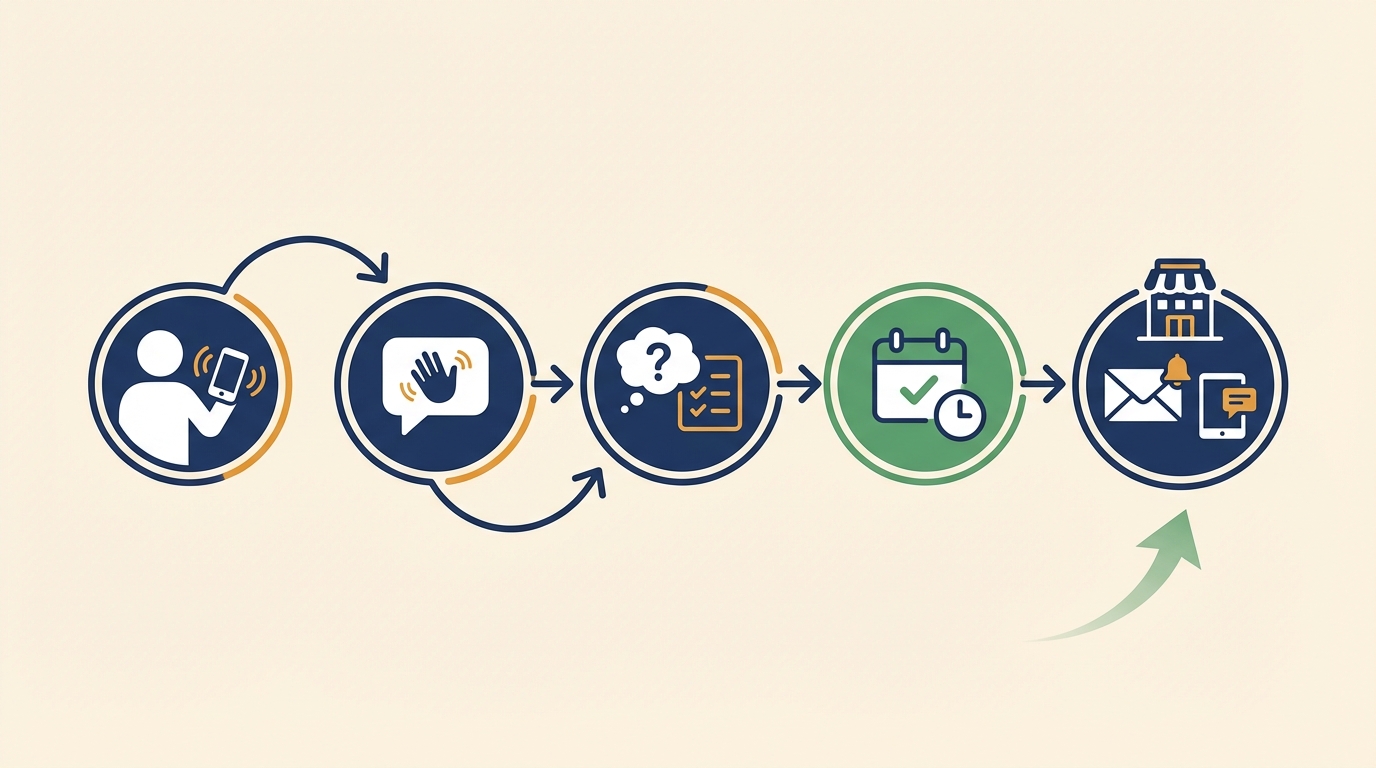
How it works
- A customer calls your business number. The AI picks up instantly — no rings, no hold music.
- The AI greets the caller by name (if they have called before) and asks how it can help.
- It qualifies the lead by asking the right questions: What service do you need? When do you need it? What is the address?
- It books the appointment directly on your calendar, checks for conflicts, and confirms the time with the caller.
- It sends you a summary — a text, email, or notification in your CRM with everything you need to know about the new lead.
The entire call takes two to three minutes. The customer hangs up with a confirmed appointment. You get a qualified lead delivered to your phone before you finish your current job.
What it handles
A well-configured AI answering service manages the tasks that eat up your day:
- After-hours calls — The 7 PM emergency request that used to go to voicemail now gets answered and booked.
- Overflow during busy periods — When you are on a job site and three calls come in at once, the AI handles all of them simultaneously.
- Basic questions — “What are your hours?” “Do you service my area?” “How much does a tune-up cost?” The AI answers instantly, freeing you for revenue-generating work.
- Appointment scheduling — Booking, rescheduling, and confirmations happen automatically.
- Lead qualification — The AI gathers the information you need and filters out spam calls, solicitors, and tire-kickers.
AI vs live answering services
Live answering services have been around for decades. They work. But for most small businesses, the math no longer makes sense when compared to AI alternatives.
Cost comparison
| Feature | Live answering service | AI answering service |
|---|---|---|
| Monthly cost | $245–$1,380+ | $30–$200 |
| Pricing model | Per minute ($2.95–$3.50/min) | Flat rate or per call |
| Cost for 400 calls/month | ~$2,390/month | ~$100–$200/month |
| Annual cost | ~$28,680 | ~$1,200–$2,400 |
Sources: Smith.ai pricing, Ruby pricing, Ambs Call Center analysis.
That is a difference of $26,000 or more per year. For a small business in Appalachia, that is the difference between hiring a part-time technician and stretching your existing crew thin.
Speed comparison
Live receptionists are humans. They handle one call at a time. During peak hours, callers wait. AI handles unlimited simultaneous calls with zero wait time.
Accuracy comparison
This is where it gets interesting. Live receptionists are friendly, but they are working from a script they may not fully understand. They might misspell a name, get an address wrong, or forget to ask a qualifying question.
AI answering services follow your intake flow exactly every time. Every required field gets filled. Every question gets asked. The data goes straight into your system without manual re-entry.
When live services still win
AI is not perfect for every situation. If your business handles emotionally sensitive calls — a funeral home, a crisis counselor, a personal injury attorney — a human voice may be the better choice. AI handles transactional calls well. Empathy-heavy calls still benefit from a real person.
The good news: most service businesses primarily receive transactional calls. “I need my AC fixed.” “Can you come look at a leak?” “I want to book a cabin for the weekend.” AI handles these flawlessly.
How to set up AI intake in 15 minutes
Setting up an AI answering service for your business is simpler than you might expect. You do not need technical skills or a dedicated IT person.
Step 1: Define your intake questions
Before you turn anything on, write down the questions your receptionist (or you) asks every caller:
- What service do you need?
- What is your name and phone number?
- What is the property address?
- When do you need the work done?
- Is this an emergency?
Most service businesses need five to eight questions. Keep it focused — the goal is to qualify the lead, not conduct an interview.
Step 2: Connect your phone number
Most AI answering services work by forwarding your existing business number. You can set it to forward all calls, forward only when you are busy, or forward only after hours. No new phone number needed.
Step 3: Configure your business details
Tell the AI about your business: your name, services offered, service area, hours, and pricing (if you want it to share ballpark estimates). The better the context you provide, the more natural the conversations sound.
Step 4: Set up your calendar integration
Connect the AI to your scheduling tool — Google Calendar, Calendly, ServiceTitan, Housecall Pro, or whatever you use. The AI will check availability in real time and book appointments without double-booking.
Step 5: Test and go live
Call your own number. Pretend to be a customer. Run through a few scenarios: a routine booking, an emergency, a question about pricing. Tweak the responses until they sound right. Then flip the switch.
Tools like Hollr are built specifically for this workflow — small business intake that works out of the box, with customization for your specific industry and service area.
Real results from service businesses
The impact of switching from voicemail (or a basic answering service) to AI intake is measurable within weeks.
What businesses typically see in the first 30 days
- 40–60% reduction in missed calls. Not zero — some callers hang up before the AI can answer, and some prefer not to talk to AI. But the improvement is dramatic.
- 2–3x more booked appointments. When every call gets answered and every caller gets offered a time slot, bookings go up significantly.
- $500–$2,000 in recovered revenue per month. The exact number depends on your call volume and average job value, but 42% of SMBs estimate they lose at least $500 monthly to missed calls alone.
- Fewer interruptions during the workday. When the AI handles routine calls, you can focus on the work in front of you and review new leads in batches.
The compound effect
The real value is not just in catching today’s calls. Every lead the AI captures is a customer you can follow up with, upsell to, and ask for a review. Over six months, a plumbing company that books five extra jobs a week at $350 each adds $91,000 in annual revenue. That is the compound effect of never missing a call.
Getting started
Missed calls are not a minor inconvenience. They are the single biggest leak in most small business revenue pipelines. An AI answering service plugs that leak for less than the cost of a part-time employee.
Here is what to do next:
- Check your missed call rate. Look at your phone system’s call log for the past 30 days. Count the calls that went to voicemail or were abandoned. The number will probably surprise you.
- Calculate your cost. Multiply missed calls by your average job value and a reasonable conversion rate (15–25%). That is what unanswered calls are costing you.
- Try an AI answering service. See how Hollr works — it is designed for small service businesses in Appalachia and sets up in minutes, not days.
Your customers are calling. Make sure someone answers.